What is an employee meal programme? A guide for UK businesses
In our recent articles, we've looked at how everyday meals can help make office days more worthwhile and why one workplace can contain hundreds of different tastes and needs.
Both lead to a bigger practical question for businesses: what does it actually mean to turn workplace meals into a programme? Because an employee meal programme isn't simply another way to order food. Nor is it just a new name for office catering or a meal stipend.
At its most useful, it's the structure behind how a business provides company-funded meals. That could include a regular meal stipend or allowance, meals on office days, food for specific teams or occasions, or a combination of these: all with clear parameters around who it's for, when it can be used and what the business contributes.
For UK businesses considering their approach to employee benefits, workplace experience or simply how they manage meals today, understanding those options (and the structure behind them) matters.
So let's start with the basics: what is an employee meal programme, how does it work, and what should businesses consider when introducing one?
What is an employee meal programme?
An employee meal programme gives a business a structured way to provide company-funded meals while giving employees flexibility over what they order.
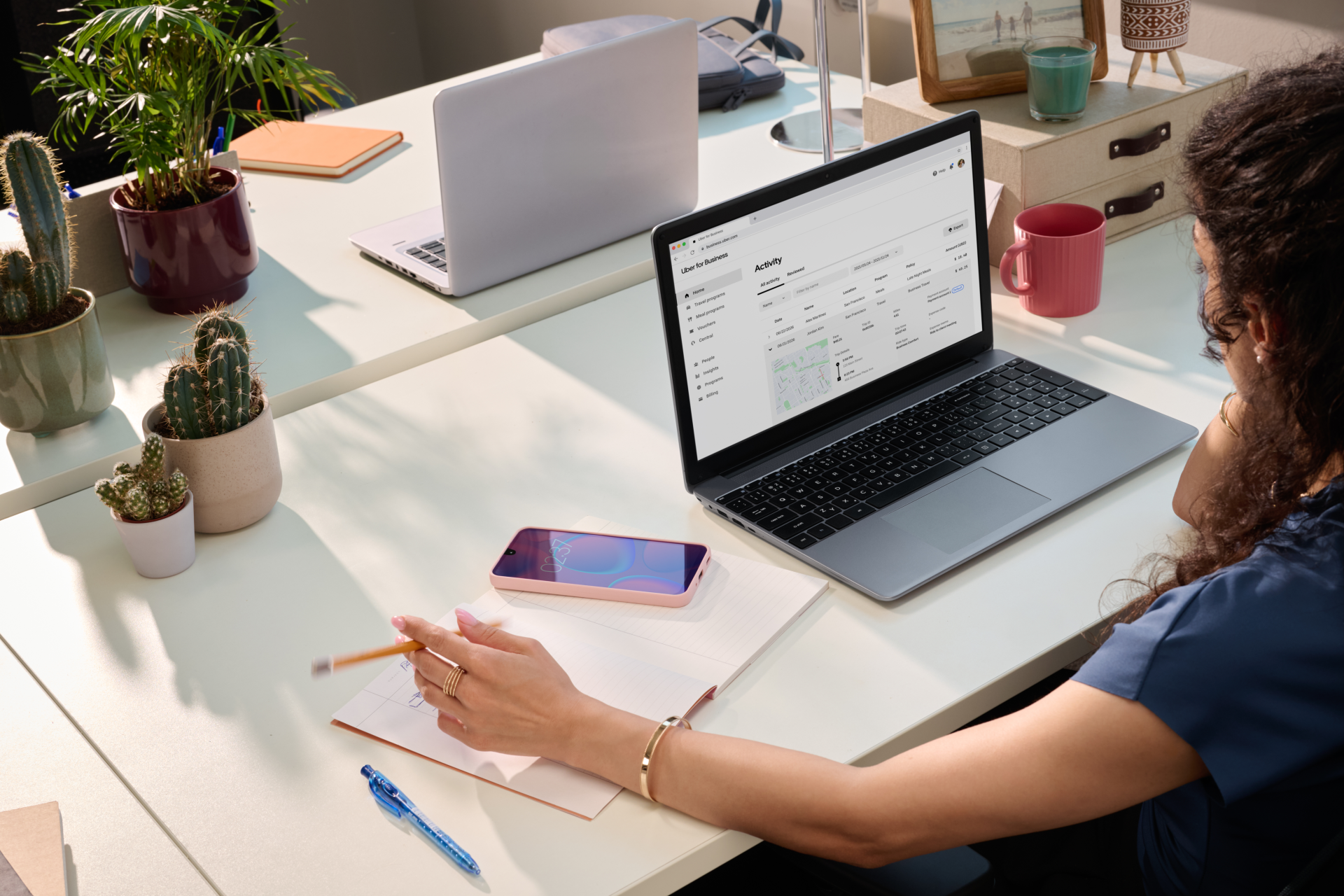
Rather than arranging every meal centrally, providing an allowance without clear parameters, or relying on employees to pay and claim the cost back afterwards, the business establishes the framework upfront. With an Uber for Business meal programme, businesses can set rules around things like budget, time and location. Employees then order within those parameters through their business profile.
It means the business doesn't need to choose everyone's food. It decides how the benefit should work, while employees choose what works for them.
Why use an employee meal programme?
Because informal processes have a habit of becoming less informal as a business grows. One team might have a regular group order. Another reimburses individual lunches. Someone in Workplace arranges food for meetings. Finance sees the expenses afterwards. Meanwhile, another office may have developed a perfectly sensible system of its own.
None of those approaches is necessarily a problem. The difficulty comes when a business wants to understand the whole picture: what it's spending, which rules apply, who is eligible and how much time different teams are spending administering it.
There is also the question of how efficiently that budget is being used. Traditional catering arrangements may involve ordering for an expected number of people or committing to agreed quantities. A more flexible meal programme can allow businesses to fund meals based on actual employee orders, helping align spend more closely with usage while giving employees greater choice over what they eat.
A meal programme puts a common structure around that activity. For employees, the experience can remain simple. For the business, there are clearer parameters behind it. And crucially, the aim isn't to create another process around food. It's to make the way you're already providing meals easier to manage and more responsive to what people actually use.
What can an employee meal programme be used for?
Think about how food actually appears across a working week. There's coffee and breakfast before an early team session. Lunch on an office day. Food during a client meeting. A late meal when someone is working beyond their usual hours. Then there are town halls, team gatherings and other moments when more people need to be catered for. Not every business will have the same mix, and that's exactly why flexibility matters.
A meal programme can provide an underlying structure across different occasions rather than requiring teams to start again each time. The needs of a Tuesday lunch and a quarterly town hall might look very different to the people eating. The process behind them doesn't always need to be. That becomes particularly useful as organisations grow across teams and locations. What works through a group chat and somebody's company card for 10 people can become surprisingly cumbersome when you're trying to do it for 100 — or 1,000.
What about choice and healthier options?
This is where workplace food has changed considerably. A single workforce rarely eats like one person. Some employees might be looking for something lighter or healthier. Others have dietary requirements to consider. Some want a local favourite, while others are perfectly happy with a familiar classic.
And despite the association food delivery can sometimes have with fast food, workplace ordering can look quite different. Uber for Business data from UK workplace orders in 2025 found that salads and bowls were the most chosen food category, followed by Halal options and wings. Around one in four of the top food-item orders was a bowl or salad.
The point isn't that an employer should decide what constitutes the right lunch. Quite the opposite. When employees have enough choice, the business doesn't need to anticipate every preference itself. People can choose something that suits their tastes and needs within the parameters the company has already established. That's a much more practical way to accommodate a workforce that was never going to agree on one menu in the first place.

What should UK businesses look for in a meal programme?
Before comparing platforms or features, it's worth looking at how meals actually happen across your business today.
Who orders them? Who approves them? Which team owns the budget? Are employees paying first and claiming back later? Are different offices doing different things? And how many processes have quietly appeared along the way? From there, a few considerations become much more useful.
Employee choice matters.
Look at whether people can find options that work across different tastes and dietary needs, including healthier choices.

Spend shouldn't be a mystery.
Consider whether budgets, eligibility and programme rules can be defined upfront and whether the business can see how the programme is being used.
Administration should decrease, not simply move elsewhere.
If a new programme still requires someone to manually coordinate every order, it hasn't solved much.

Different occasions should be manageable within the same approach.
Breakfast, an office lunch and a larger team moment don't need to look identical, but nor should each require a completely separate process.
And finally, think about scale before you need it. The earlier that structure is in place, the less businesses need to rely on manual workarounds as they grow.
Who benefits from an employee meal programme?
The obvious answer is employees. But they're only part of the picture. For People teams, workplace meals can form part of an employee experience that feels useful rather than ornamental. For Workplace teams, a programme can reduce the need to coordinate individual food requests and different arrangements for every occasion. Finance and Procurement teams can benefit from clearer budgets, rules and visibility over company-funded meals.
And employees don't need to understand any of that infrastructure. Ideally, they simply know what they can use, when they can use it and how to choose something they actually want to eat. That's a useful benchmark for any workplace programme: the complexity should sit behind the experience, not inside it.
From buying meals to managing them better
Most businesses considering a meal programme aren't starting from zero. Food is probably already being ordered. Employees may already be submitting expenses. Teams are already having lunch together. Someone is already arranging breakfast for that 8:30 meeting or sorting food for the next town hall.
So introducing a meal programme isn't necessarily about adding another employee perk. It can simply mean taking something that's already happening across the business and asking whether there's a better way to run it. A way that gives employees meaningful choice without asking someone else to manage every preference. A way that gives the business visibility without making the employee experience feel restrictive. And a way that still works when one team becomes five, one office becomes three, or an occasional meal becomes a regular part of working life. Because ultimately, buying food solves the meal in front of you. A meal programme solves for what happens next.
More choice for employees. Made manageable for business.
We partner with 75,000+ of the UK's beloved brands, giving employees access to 100,000+ local restaurants in the Uber Eats app, with an average delivery time of under 30 minutes. With an Uber for Business meal programme, businesses can set budgets and rules in one dashboard, keep business and personal receipts separate, and access 24/7 support — bringing together the choice employees value with the control businesses need.
See what Uber for Business meal programmes can do for your team →
Select your preferred language
Overview
About us
Products
Solutions
By use case
By industry
Customer support
Support
Resources
Find out