Supporting Economic Opportunity in WA
When ridesharing first came to Perth in October 2014, no one could have imagined how the simple act of sharing a ride could make Perth a more livable, economically vibrant and better connected place to be.
Now anyone, anywhere in Perth can push a button and get a ride in minutes; thousands of Western Australians have access to extra work whenever they want, and extra money whenever they need it; and suburbs traditionally underserved by public transport, such as Ellenbrook, Mirrabooka and Spearwood have been reconnected to the rest of the city.
One of the main reasons ridesharing is having such a positive impact in Perth, is because sharing rides offers local residents the kind of work they want: work that provides a good income with the autonomy, flexibility, and dignity that comes with being their own boss
‘Driving an hour or two, here or there, to help pay the bills’
For most people, driving on Uber is not even a part-time job. It’s just driving an hour or two a day, here or there, to help pay the bills, transition between jobs or supplement their existing income.
In fact, according to a recent survey of over 1500 Western Australian driver-partners:
- 72% of partners were employed when they signed up to drive on the Uber platform.
- 56% of partners say they drive “to earn more money to better support myself or my family”.
- 27% of partners say they drive “to earn money while looking for full-time/part-time employment”.
- 26% of partners say they drive “to supplement my existing income (e.g. from a full-time/part-time job or pension)”.
Supporting economic opportunity
The Government is in the process of reviewing the on-demand transport industry, and has committed to introducing ridesharing regulations by the middle of this year.
While this should be good news for ridesharing participants, the Government has made it clear that it is thinking about adding new fees to drivers and cars in addition to its existing accreditation fees, which already cost over $300 and are by far the highest in the country.
For comparison, in states with ridesharing regulations, such as NSW and the ACT, ridesharing fees are low and designed to cover the cost of administration only. Placing high fees on Western Australians disadvantages them unnecessarily.

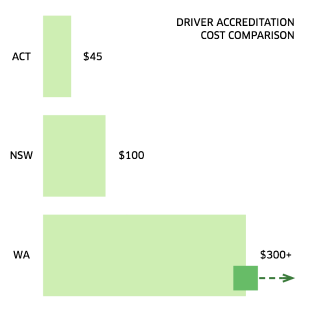
When we asked our driver-partners how fees would impact their ability to get on the road, nearly two thirds of partners said an upfront cost of more than $250 would prevent them from being able to sign up to drive on the Uber platform.
It is clear the Government is failing to understand that for most drivers, ridesharing is simply a flexible way to supplement their income, by sharing rides in their private car.
In an era of stagnant wages and rising cost of living, ridesharing gives people an opportunity to earn additional income, bridge gaps in work, and provide for their family, all with the flexibility to work when, where and how they want. It is critical that the right to access flexible work is not restricted by prohibitive and arbitrary regulation, including excessive licence fees that are more than the basic cost of administration.
In 2016, opening up economic opportunities and supporting Western Australians’ right to access flexible work easily is something the Government needs to get behind and support.