
Safety guidelines for autonomous mobility and delivery on the Uber Platform
January 5 / US
Uber’s Vision for Autonomous Mobility & Delivery
Uber’s mission is to reimagine the way the world moves for the better, and autonomous vehicles (AVs) are part of that vision. We expect AVs to increasingly contribute to Uber’s business over time, as part of a hybrid network featuring AVs operating alongside conventional vehicles. This hybrid network approach has the potential to expand transportation and delivery access, further promote safety, and unlock new use cases. We intend to ensure Uber continues to provide the best mobility and delivery offerings in a future with AVs.
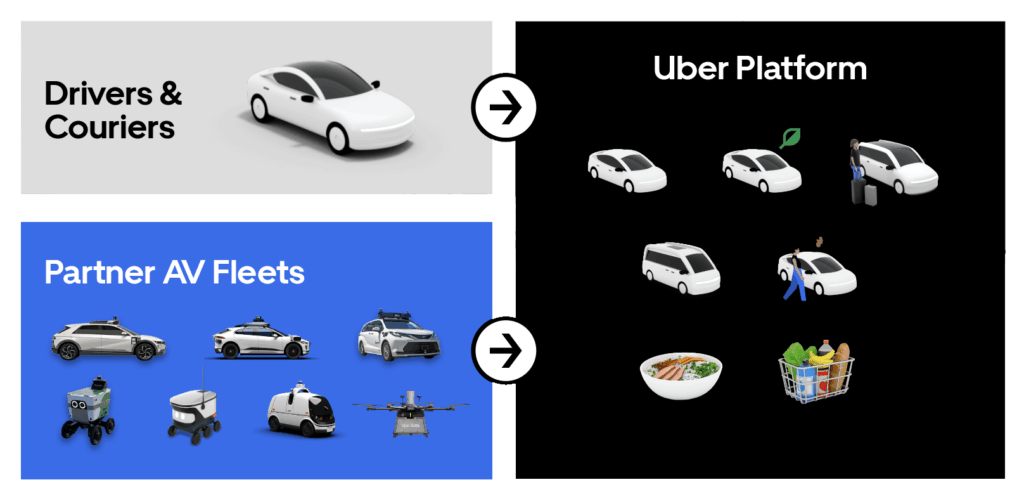
Our approach is to partner with autonomous vehicle developers, fleet operators, and cities to help connect consumers with AV services that:
- Create new opportunities and improve productivity for our customers and partners
- Meet our own robust expectations for security, privacy, and safety
- Promote equity and positive environmental outcomes in our communities
Standing for Safety

When it comes to safety here at Uber, our work is never done. Safety is a major consideration for all transportation types, and we take our role in promoting safety in mobility and delivery seriously. As we introduce additional autonomous vehicle partners onto our platform and into your communities, safety will be at the fore.
Our partners develop and build the technology necessary to power autonomous vehicles with safety in mind. Uber has also implemented a comprehensive safety program, in which we review potential partners’ approaches to safety before they deploy and operate on the Uber network across mobility and delivery use cases.
Introducing Uber’s updated safety guidelines for autonomous mobility and delivery on the Uber Platform
At Uber, safety isn’t a box we check; it’s a value embedded in everything we do. Since launching our Safety Guidelines for Autonomous Mobility Providers three years ago, this framework has guided every automated vehicle operating on our platform, helping ensure consistency, accountability, and public trust as new mobility and delivery technologies have come online. Today, we’re excited to share an evolution of that proven foundation, an update informed by years of operational insight and the onboarding of new autonomous modalities. This expanded scope embraces emerging technologies, delivery modes, and safety domains while staying grounded in the principles that already define how we operate safely at scale.
Regulations for automated vehicles continue to advance, and we welcome that progress. Compliance has never been our ceiling; it’s our baseline. Our guidelines work alongside regulatory frameworks and industry best practices to ensure consistency across partners, technologies, and regions. It’s how we hold ourselves and our partners to a higher standard, grounded not just in policy but in our responsibility to the people and communities we serve.
Preparing for the next chapter
As AV technology advances, so must our framework, adding clarity where it matters most, factoring in nuances, and extending it to new domains. Together, these updates strengthen a framework that’s already working, ensuring we stay proactive as technology and expectations evolve. The Autonomous Mobility & Delivery Safety Guidelines have been updated to reflect:
- New AI standards
- Advances in AV industry safety standards
- Food safety for sidewalk robots
- Delivery drone safety
Uber’s updated Safety Guidelines for Autonomous Mobility & Delivery Providers reflect three years of real-world AV deployment experience and deeper collaboration with industry standards bodies, including the AVSC, SAE, IEEE, and ISO. The new edition strengthens expectations for how partners demonstrate their safety approach, enhances transparency across testing and validation practices, and introduces expanded guidance for emerging modalities such as airspace delivery. These updates, shaped by evolving technology, regulatory progress, and Uber’s active role in defining best practices, underscore our commitment to safety, accountability, and the responsible growth of autonomous services on the Uber platform.
Safety program for Autonomous Mobility & Delivery
For non-autonomous vehicles, federal regulatory standards govern vehicle design and state and local rules govern vehicle fleet operations. Outside of a few places, regulatory frameworks governing the commercial operations of AVs remain under development.
While regulations continue to evolve, Uber can take its own steps to develop an understanding of how our potential partners plan on approaching AV safety for any operations involving the Uber platform.
As such, it is the goal of the AM&D Safety Program to implement a safety framework that:
- defines a comprehensive and pragmatic strategy for understanding how potential partners would approach the safety of any operations on the Uber platform,
- creates a consistent assessment process, rooted in applicable industry safety standards and best practices,
- establishes the baseline for automated and& autonomous robots and vehicles to deploy and continue operation on the Uber network across mobility and delivery use cases.
The program is organized into three phases: first, planning, then demonstration, and ultimately operation, with clear reporting on safety performance. This program identifies the AV fleet partner obligations that are expected to be met each step of the way.
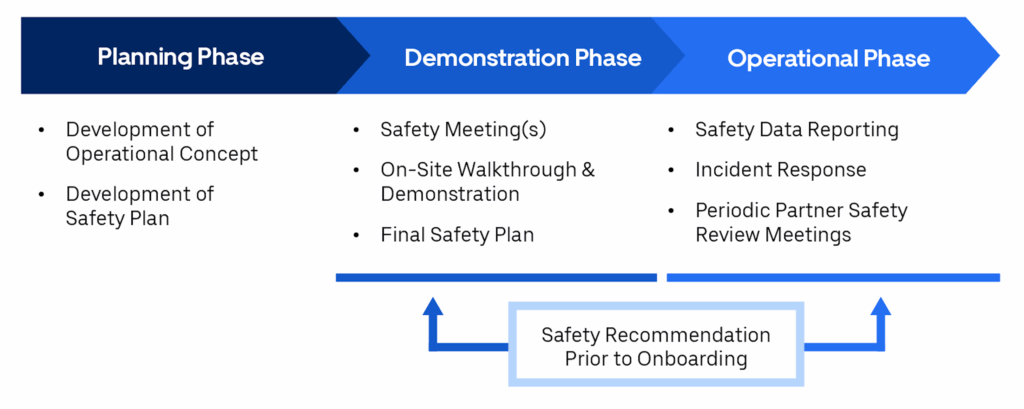
Safety Plan Assessment Framework
Although the use of a Safety Plan in Uber’s safety program is consistent across operators, we recognize that partner approaches to safety may vary significantly from one to the next. As a result, the Uber AM&D safety assessment does not prescribe a single safety standard or a singular metric and threshold against which the safety performance of all partners is measured. Rather, the AM&D Safety team looks to assess each partner’s Safety Plan on its own terms, in reference to the particular partner’s planned scope of operations. The safety plan assessment framework is organized into three safety components that are complementary to each other and ensure that Uber is assessing a partner’s comprehensive approach to safety rather than only assessing individual topics such as safety metrics or verification and validation approaches.
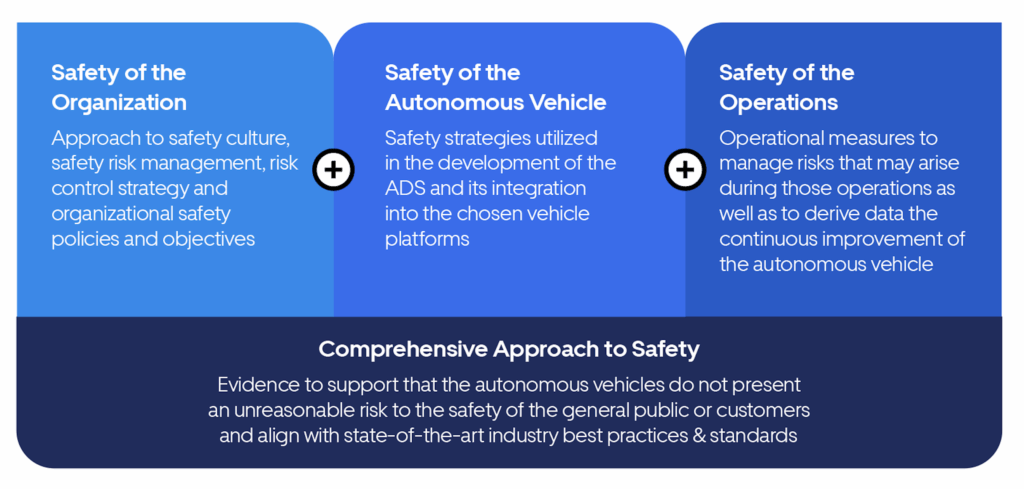
Collaboration as the path forward
We know that safety innovation doesn’t happen in isolation. It’s built through collaboration across our cross-functional stakeholders, including AV developers, AV fleet operators, OEMs, regulators, researchers, and users. And that’s what we’re committed to.
The best place to deploy autonomous vehicles is one built on trust, transparency, and shared responsibility. That’s what we’re building at Uber, every day, with every partner, in every community we serve.
Ultimately, this collaborative work should support the safe commercialization of AVs by promoting a transparent, consistent, thorough approach to safety across partners on our platform.
To learn more about our Safety Guidelines for Autonomous Mobility and Delivery Providers on the Uber Platform, download the full report here.
Posted by Uber